
Your Customer Experience Will Fail Without These Two Things
Most customer experience initiatives don’t fail because companies lack vision. They fail because vision never makes it to the frontline—and feedback never turns into action. Organizations invest heavily in CX strategies and customer listening programs, yet day-to-day experiences remain unchanged. Why? Because responsibility is unclear, frontline teams aren’t equipped to act, and continuous improvement isn’t connected to what customers are actually saying. Without these fundamentals in place, even the best CX strategy will stall.
I have an example. The company started a CX program. They collected the customer feedback. The feedback was evident on many of the things that needed to change. But there was no way to improve customers’ daily experiences. Why? Management was supportive of getting feedback, but not of changing things customers saw as weaknesses. Part of it was internal resistance, but the central part was that there was no way to change the things that needed changing. Everyone and, ultimately, customer experience will fail without someone being responsible for making the changes. Why? Read on!
Three Key Elements
Even with a crystal-clear strategy, customer experience will fail without two other key elements are needed. These are a ready-made frontline, a straightforward integration between CX and what customers are saying, and continuous process improvement (CI).
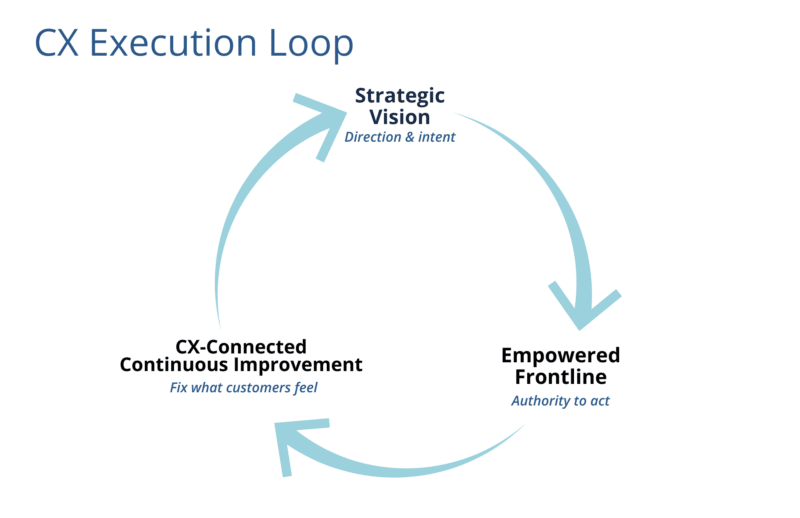
Let’s take each element in turn:
1. Strategic vision
The very essence of leadership is that you have to have vision. You can’t blow an uncertain trumpet (Theodore Hesburgh). Employees need to know where CX fits into the other work they do and why it matters to the organization. Without clarity around the CX vision, it is genuinely an uncertain trumpet.
I have several examples of companies with clear visions of how better CX fits into their companies’ long-term plans.
Navistar, now International Motors, is my first example. In 2019, the President of aftersales and alliance management, Friedrich Baumann, said Vision 2025 represents a shift from… to a “customer-centric, innovative brand.” Baumann said that selling more trucks and boosting market share are obviously goals for Navistar. Still, Vision 2025 is also about “becoming the premier solutions provider and OEM of choice for our customers.”
John Deere is another example of a company with a clear vision. Their official statement is: “Become the world’s leading agriculture and construction solutions provider… helping customers thrive in challenging global conditions.” The statement focuses on long-term leadership in customer-centric solutions for agriculture and construction. There are other examples I could include, but let’s focus on how a clear vision helps. There are three primary ways a clear vision helps in your CX improvement efforts.
Guides strategic decision-making: When managers need to make investment or other strategic decisions, the statement provides guidance. I suspect this vision, which has been in place for a while, has influenced John Deere’s investment and other strategies around improving farmer productivity.
Influences daily decisions: We have a client that is a large organization. There was a problem with a major repair on a key piece of a customer’s equipment. A part was not delivered on time. Part of the repair was not done correctly. The customer was in a pickle because he needed to finish a significant project. So, the company provided a loaner to help the customer. Nothing unusual about this except that the loaner was free. Whose budget was going to take the hit? In the end, the head of parts, the head of service, and the head of rental all shared the cost because they knew what the company expected of them. I have personally seen many examples of how the company’s vision guides decisions throughout the organization.
Creates a common language around which people can coalesce. Financial measures are always a common language in a company, sometimes too much so. But so too can a vision. For example, people can talk about service experiences they deliver, both good and bad. This helps frontline workers to learn.
2. Empowered Frontline
A company can have the most compelling vision statement and strategy, but without a frontline ready to go, little happens. Drucker said it best, “Culture eats strategy for breakfast.” In the industrial B2B space, each delivery location or point has its own culture. The culture needs to align with strategy:
Well-Trained: Frontline workers must have training in both technical skills and hard and soft skills. After all, the frontline delivers the experience. Having people well-trained in technical skills is not sufficient. They must understand the importance of connecting with customers emotionally to deliver excellent experiences.
Right tools: This is not just what might be in a toolbox. Now, customers want quick and easy communication. Now, having the right tools means those that allow the service deliverer to communicate quickly and easily with the customer.
We recently moved into a new home. The company that installed and now services our HVAC system provides a tracking system, with notifications, to let me know when the technician will arrive. I now expect that from every service provider.
Well-led: The frontline worker’s job in many industrial situations is challenging. Having effective leaders who (1) treat people with respect and (2) hold them accountable is essential. Too often, this is missing. Developing these frontline leaders with great coaching and training is essential.
CX-Connected Continuous Improvement
I highlighted an example of a company whose CX improvement efforts failed. One of the primary reasons for the failure was that the continuous improvement process was not connected to CX. In fact, the continuous improvement team was almost exclusively working on IT CI. The company had many system and process issues, yet there was no way to fix them. No one was responsible for improving the processes, even though customers constantly highlighted many of the issues. Employees were undoubtedly aware of many of the issues, but were unable to fix them. There must be an effective way to respond to and resolve client issues. Often, these issues are caused by poor processes.
Final Thoughts
I have not mentioned analytics or AI. Both are needed in today’s B2B environments, but neither is sufficient on its own. I have yet to see someone, even the most talented analytics person, singlehandedly improve customer experience from behind a laptop. Yes, analytics can point you in the right direction.
AI can help improve productivity and effectiveness in many cases. But these are tools! They cannot replace understanding the human environment that managers and frontline workers experience daily.
Get Started Today
Let’s deliver exceptional experiences that drive growth and customer loyalty.
