
Customer Experience for Frontline Employees: Why Good Training Matters
Customers say the darndest—and often most unexpected—things. Your frontline employees must be prepared to manage that feedback effectively and act on it with confidence. Effective Customer Experience training for frontline employees ensures customer experience strategy becomes reality in everyday interactions.
Too often, they aren’t ready.
Why?
Think about the best technicians or parts counter professionals you’ve known. They were likely hired for their technical expertise and product knowledge. Those skills were further refined through additional technical training.
But in many cases, the so-called “soft skills”—effective communication, conflict management, and active listening—are overlooked. Even more concerning, frontline employees are often not empowered to act on customer feedback.
When that happens, your CX process breaks down.
What Happens When the CX Process Breaks Down?
A well-functioning CX improvement program operates as a continuous loop. The CX Execution Loop begins with a clear strategic vision of how customer experience supports the company’s overall strategy. Well-trained and empowered frontline employees bring that vision to life in real customer interactions. (Kris, should we include the CX Execution Loop graphic?)
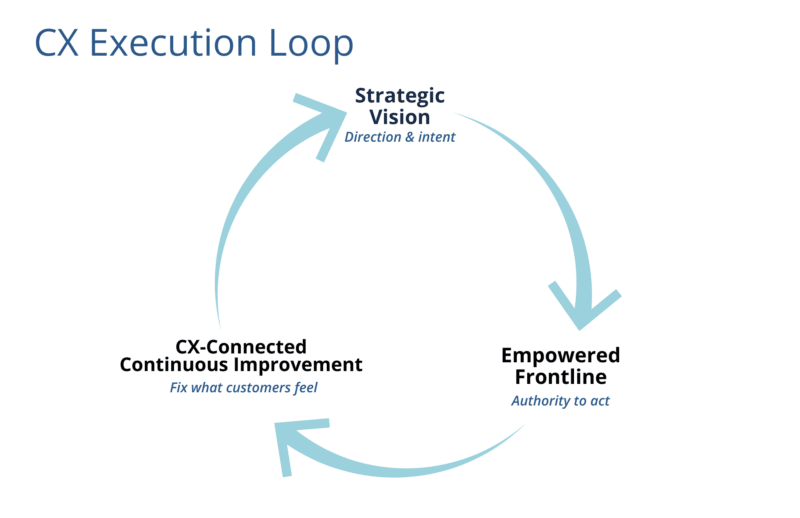
Customer feedback—especially feedback that highlights broader, systemic issues—then feeds into ongoing process improvement efforts. The loop continues.
However, even if your organization is making significant progress improving systems and processes, the CX improvement effort can stall if frontline employees are not well-trained and empowered to act in the moment.
So, what kind of training actually works?
Training That Works—What to Consider
I’ve experienced both effective and ineffective training. Those experiences have taught me what truly makes training stick.
1. Training Must Be Built Around Your Company’s Critical Needs
Your customer feedback tells you what matters most.
Let me share a simple example. Early in my career, I started in a sales role and participated in several training programs during my first year, so many that I sometimes felt like I spent more time in training than selling.
One session focused specifically on handling upset customers. At that point in my career, I had not yet dealt with an angry customer. But the very week after that training ended, I encountered one.
Because the company anticipated that situation, they equipped me with practical tools and language I could use. The training helped me navigate a delicate conversation and create a win-win outcome for both the customer and the company.
That experience stayed with me. The company didn’t train for theory—they trained for reality.
The most effective training is built around the real challenges your employees are likely to face.
2. Training Must Engage Participants and Compel Action
Training cannot be passive.
If your program includes in-person components, role-playing is one of the most powerful engagement tools available. Through structured practice, employees gain confidence and build muscle memory for difficult conversations.
That’s exactly what happened to me. When I faced my first angry customer, the training “kicked in.” The practice made it stick.
Even in virtual or hybrid environments, engagement is possible. Quizzes, simulations, gamification, breakout discussions, and scenario-based exercises reinforce learning and encourage application.
Confidence comes from practice—not PowerPoint slides.
3. Training Must Align With How Adults Learn
Adults learn differently than children. Effective training acknowledges that.
Adults learn best when:
- You start with the “why.” Open sessions with clear WIIFM (“What’s In It For Me?”) outcomes.
- You build in choice and flexibility. Offer modular paths, optional deep dives, or learner-set goals.
- You use experience-rich activities. Incorporate real case studies, peer sharing, role-play, and reflection.
- You make learning practical and immediate. Provide hands-on application, job aids, and reinforcement tools.
- You personalize when possible. Relevance increases retention.
When training feels practical, applicable, and respectful of experience, engagement increases dramatically.
4. Measure Results Beyond Course Completion
Training completion rates don’t equal impact.
Effective training measures behavior change, real-world application, and business outcomes. Focus on observable improvements in customer interactions, problem resolution, and customer feedback trends.
Many organizations find ROI measurement intimidating—but it doesn’t have to be. Start small. Identify one or two behavioral metrics tied directly to customer outcomes.
Most importantly, create a positive, encouraging learning environment. When employees feel safe to learn and practice, they are far more willing to stretch and grow.
Bringing It Back to the CX Execution Loop
Returning to the CX Execution Loop: frontline employees who are well-trained and empowered to solve customer problems are essential to keeping the loop functioning.
Strategy alone isn’t enough. Process improvements aren’t enough.
Your frontline team is where CX becomes real.
Are you providing the training your frontline teams truly need?
Lynn Daniel
If you’d like to explore how we can elevate your frontline training and strengthen your CX execution, click here to learn more about our training options. Let’s take your training to the next level.
Get Started Today
Let’s deliver exceptional experiences that drive growth and customer loyalty.
