
How Better Customer Experience Drives Growth in B2B Companies
In today’s B2B landscape, customer experience has become one of the few remaining levers of real differentiation. Competing on product or price alone is no longer enough—customers expect every interaction to be consistent, responsive, and easy. Companies that deliver on those expectations don’t just earn goodwill; they earn growth. The link between experience and performance is no longer theoretical—it’s measurable, and it’s widening the gap between CX leaders and everyone else.
This two-part series explores the financial benefits companies can achieve through a more substantial customer experience (CX). Drawing on both industry research and insights from The Daniel Group’s own analysis, the series examines how organizations can turn CX investments into measurable performance gains—and how to overcome common barriers that prevent progress.
An article of faith is a firmly held belief. Well, many companies have adopted CX improvement efforts as an article of faith. Globally, in 2023, companies spent $11.4 billion on customer experience management services. This number is projected to grow at 12.2% annually. What are some of the benefits that some of the companies investing in CX are realizing? Let’s see!
Financial Benefits—There Are Plenty
- Research from McKinsey shows that B2B customer experience leaders “have, on average, higher margins than their competitors. In cases where companies have undertaken broad transformations of their customer-experience processes, the results have been reductions of 10 to 20 percent in costs to serve” (Improving the business-to-business customer experience, McKinsey, 2016).
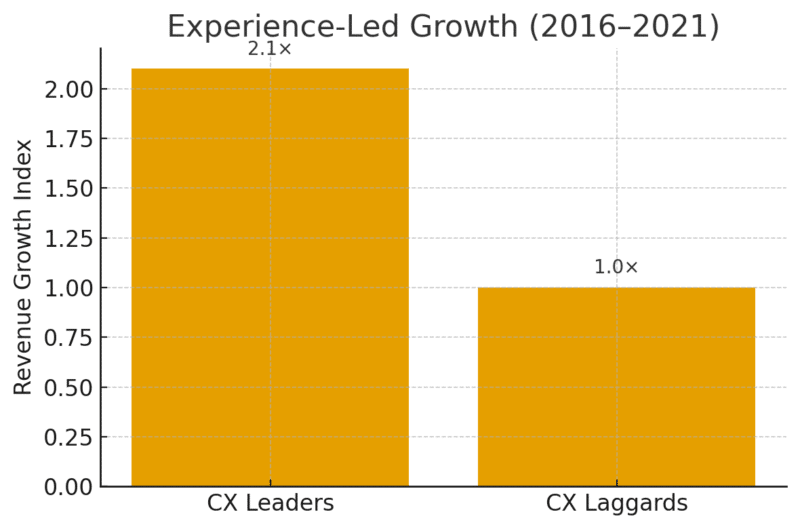
- Additional research from McKinsey in 2023 shows that customer experience leaders grow faster than their peers. This analysis revealed that companies classified as CX leaders achieved more than double the revenue growth of “CX laggards” between 2016 and 2021 (see chart below).
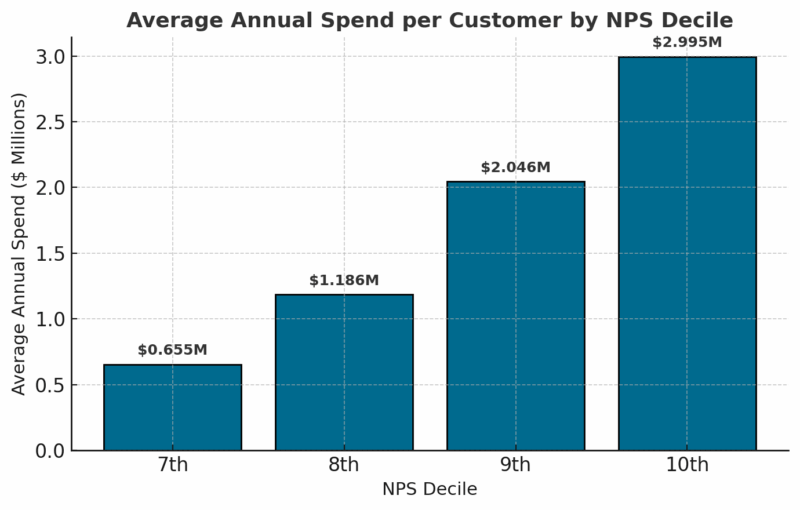
- Our own research findings are consistent with the above chart. We compared the invoice revenue for each customer in our database with their NPS ratings. We compared the Average Annual Spend with the NPS decile where the respondents’ scores fell. For example, customers whose NPS scores fell in the 10th decile (giving a 9 or 10 on the NPS question) had an annual spend of just under $3 million. However, for those customers whose score fell in the 7th decile, their average spend was only $655,000, or about a $2,339,000 difference.
As you can see from our research and that of outside companies, there are clear financial benefits from improved CX.
Challenge—making the CX investment payoff
Given the amount of energy and resources going into improving CX, I expect more instances of better service. However, I rarely receive positively memorable service. The American Customer Satisfaction Index seems to confirm my observations, as the customer satisfaction level has declined for the past three quarters. One of the reasons is an excessive focus on technology and a failure to address other areas that are critical to better CX. Three significant elements need attention:
- Processes (including technology): Too often, technology is slapped on top of poor processes, in the hopes that technology will solve the problem. This approach is a critical mistake. If processes are weak or broken, a new piece of technology is unlikely to help much, if at all, and may only lead to further frustration.
- Culture: This element often hinders many CX improvement efforts. Unwillingness to change, too little autonomy to help customers solve their problems, and an overweening focus on financial measures at the expense of a satisfied customer. These, and others, are significant cultural factors that hinder the creation of a better customer experience.
- People: Are they engaged? Do they understand what a good experience looks like from the customer’s perspective? Are they well-trained in the technical side of what they do, and the “hard” soft skills stuff? These matter if you want to deliver superior CX
Better CX can pay off in significant ways. The challenge is making it happen.
Today, more than ever, having a better customer experience is a crucial asset in your strategic arsenal. It helps to set your business apart from others. But as the McKinsey articles point out, not all companies are having success in their efforts. There are “leaders” and “laggards.” Focusing on other vital elements like culture, people, and processes is essential to improving CX. Also, listening to what your customers say, not just the score they give, is critical.
Let us know how your CX efforts are working. What things have you discovered that really create better experiences for your customers? What measurable benefits do you see from better CX?
Get Started Today
Let’s deliver exceptional experiences that drive growth and customer loyalty.
